
The Glascock County Multi-Day Arrest Log
The official feed lives on McDuffie InteropWeb's Inmates By Arrest Date page. It's built for date-range searching. Enter From and To dates, pick a calendar span, add a name filter if you have one, and hit Search Inmates. A wide range can stretch across many pages. Results aren't a promised archive size. Glascock arrestees appear because they're housed in Thomson. State and nearby agencies show up too, so check for GLASCOCK COUNTY SO in the arresting-agency field before counting a row as a Glascock sheriff arrest.
The official date-range feed is shown below.
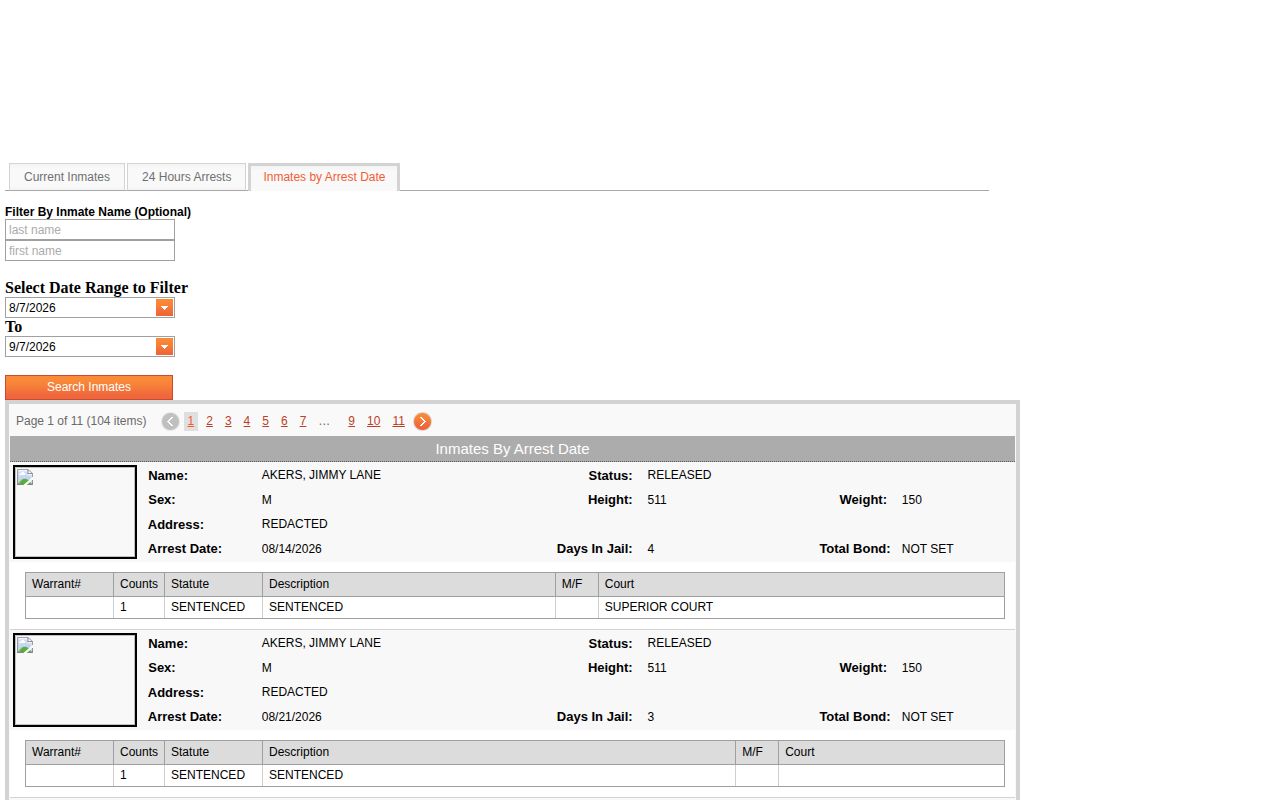
The controls make it a multi-day tool, unlike the rolling same-day screen.
How to Read the Glascock County Blotter
Match the range to the event instead of assuming seven days. Write down the dates used so the search can be repeated later.
- Enter the beginning and ending arrest dates.
- Add first or last name when known, allowing for spelling variants.
- Run Search Inmates and review every result page.
- Confirm the arresting agency, arrest date, status, and identity details.
- Read RELEASED and CURRENTLY BOOKED as custody labels, not case outcomes.
- Ask the custodian for records beyond the web window.
Booked within the rolling day? Use the 24 Hour Arrests route. The date-range log serves you better after a quick release, after several days, or when the exact booking day is a guess.
What a Glascock Arrest-Log Entry Shows
Each entry carries the same core booking fields as the current portal, though completeness can vary from row to row.
| Field | Meaning and limit |
|---|---|
| Name and demographics | Identity clues that should be cross-checked for common names. |
| Status | Currently booked or released at the time recorded. |
| Arrest date and agency | The key Glascock Sheriff verification fields. |
| Days in jail and bond | Custody data that can change. |
| Warrant, count, statute, description, court | Charge-side details. |
| Image control | An image slot may appear, but no photo is guaranteed. |
The redacted address should stay redacted. A booking photo is an identification image, nothing more.
Glascock Arrests Across Weekends and Holidays
A longer range can bridge Friday through Monday. InteropWeb gives no refresh timestamp. Booking can trail the arrest by hours. Set dates on both sides of the period, then scan every agency field. If a row stays absent, check current custody and call the sheriff or jail, because an online gap is not reliable proof.
Glascock Arrest Archives Beyond the Portal
The portal names no maximum date range. It also promises nothing about how long entries stay searchable. Georgia's retention schedule offers a baseline instead. Jail booking records are kept at least ten years after release, and jail registers ten years after the last entry, though classification and agency practice control. For the arrest file, ask the Glascock Sheriff. For the booking record, use the McDuffie Sheriff request page. A written request should name the person, the approximate date, the agency, and the fields you want. Georgia AG guidance gives offices three business days to produce records, give a timetable and cost estimate, or cite an exemption. No one has to create a new report. Older permanent county records can transfer to Georgia Archives. No public name-searchable historical Glascock booking database exists. Start with the originating office. Ask whether a transfer happened. Press the custodian for a specific answer. Four replies mean different things: not online, not held here, destroyed under a schedule, or restricted by law. Each answer points to a different next step. If McDuffie says a jail file transferred, request the series title, date span, accession number, and destination. And if the jail record can't answer the case question, the Glascock court clerk may still hold a docket or filed disposition.
Archive note: online roll-off does not prove destruction, restriction, correction, or a favorable court result.
How Local News Covers Glascock Arrests
Local news coverage is selective. CSRA Crime keeps a Glascock landing page, AugustaCrime a county tag, and The News and Farmer or Jefferson Reporter fills the weekly-paper role. None of them is the official custodian, and none proves current custody. The CSRA Crime county page is a secondary source.
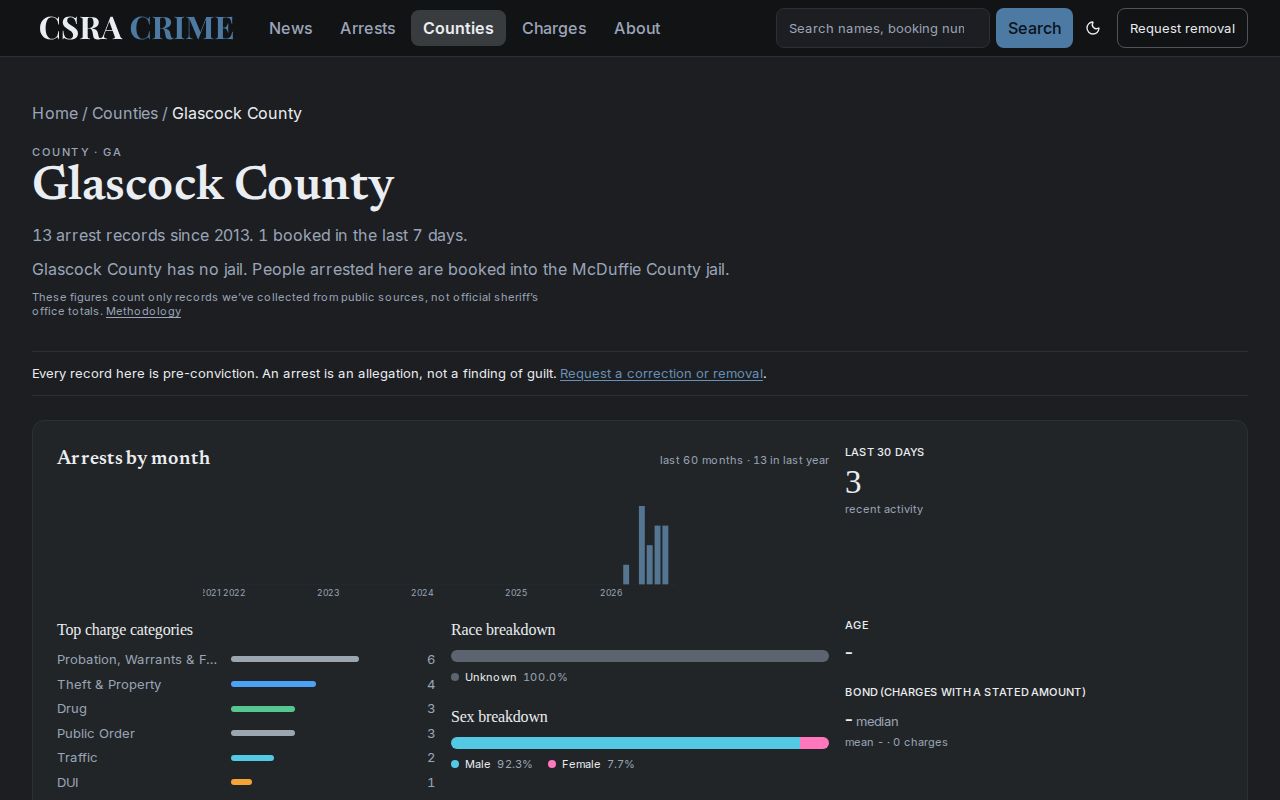
Its labels can lead you to a name. The facts still need official confirmation. AugustaCrime also runs a Glascock County tag, though it can be incomplete or stale and settles nothing, so treat it as a lead to verify.
Glascock Arrest Reports in the Weekly Paper
The News and Farmer site may run selected safety and court items. It's no complete ledger. Editorial choice and issue dates decide what runs, so a missing name proves nothing.
Use news for leads, then confirm identity, custody, and outcome through official channels. Georgia Historic Newspapers holds dated issues you can search. Older local reporting, including Glascock Sheriff references, sits in there. It shows only what was printed. That archive cannot reveal present custody. It also cannot show a live warrant or the current form of a charge. Keep the issue date with any citation, then return to the agency or court for the official record.
Why Glascock Arrest Results Mix Agencies
Glascock County does not jail people at home. It has no jail of its own. Local arrests get booked through a shared regional facility. The results page mixes rows from many agencies as a result. A search across a wide date range can return plenty of rows. Only a handful are tied to the Glascock Sheriff. Adding up every row would overstate local arrest activity in the county. Depth on a page is not a crime trend, and a weekend cluster proves even less. Counts shift with dates, releases, and which agencies the portal served. For real statistics, use a defined official dataset.
City names deserve the same caution. Gibson, Mitchell, and Edgehill publish no municipal arrest log or police blotter of their own. The regional plan names the Glascock County Sheriff's Office as the county's only law-enforcement provider. A city can still surface in narrative text. The arresting-agency field is the better sign of a sheriff booking. State officers also arrest people inside Glascock County. They book them into the same receiving facility. Those rows may lack the sheriff label yet still matter locally. When place is the question, request the underlying arrest record. Do not stretch the portal beyond its design.
Glascock Arrest Logs Do Not Decide Guilt
Note: A Glascock County booking charge only reflects custody status and may change or drop as the court process moves forward.
How a case ends is a court matter. Court records hold the disposition. The county recent-arrests hub keeps jail, court, prison, and records-request channels separate so nothing gets confused. Good notes save trouble: record the date range you searched, the agency label, the status shown, and the time checked. Then pull that person's court record. That habit keeps a passing custody label apart from a lasting public record. It also guards against later portal changes.
Court searches need equal care. Match name and case to the right Glascock court. Charge wording on a docket may differ from the booking wording. Magistrate and Probate handle defined local matters, while Superior Court records can be reached through Georgia's court e-Access provider directory. A docket entry can omit filed documents. If an official entry looks wrong, contact the office that created or maintains it, and keep copies of each request and reply, since a fix at one source is not a fix everywhere.